About Me

For more than 20 years, I have designed and built distributed software systems, business-critical platforms and scalable backend architectures.

Today, I bring the same engineering discipline to AI. My focus is building production-grade AI systems using Retrieval-Augmented Generation (RAG), AI agents and LLM evaluation frameworks.

I believe successful AI products require much more than calling an LLM API. They need solid software architecture, automated testing, observability, monitoring and deployment strategies that make them reliable in production.

Beyond building software, I enjoy sharing what I learn through open-source projects and technical writing, helping other engineers better understand how modern AI systems are designed and evaluated.

ENGINEERING EXPERTISE

The engineering disciplines that shape how I design reliable software and AI systems.

Software Architecture

Domain-Driven Design (DDD)
Clean Architecture
Hexagonal Architecture
Backend Architecture
API Design
Event-Driven Architecture
Distributed Systems
Identity & Access Management
Performance Engineering

AI Engineering

LLM Engineering
Retrieval-Augmented Generation (RAG)
AI Agents (LangGraph, LangChain, MCP)
AI Evaluation (DeepEval, RAGAS, LLM-as-a-Judge)
Semantic Search & Vector Databases
Machine Learning
AI Observability
Prompt Engineering

Selected Engineering Projects

Each case study explores a different engineering challenge, from software architecture and domain modeling to RAG pipelines, AI agents and LLM evaluation. Together, they reflect the engineering principles I apply when building production-grade AI systems.

Mission Radar AI

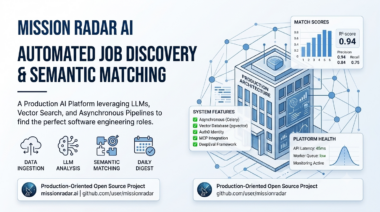
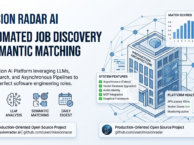
Production AI platform that automatically discovers, analyzes and semantically matches software engineering opportunities using LLMs, vector search and asynchronous workflows.

View More

Mission Radar AI

AI /

Url
https://mission-radar.stefanoalletti.com
Repository Gtihub
https://github.com/salletti/mission-radar-ai

Production AI Platform for Automated Job Discovery and Semantic Matching


Executive Summary

Mission Radar AI is a production-oriented AI platform that continuously discovers software engineering opportunities, analyzes job descriptions using Large Language Models, semantically matches them against a developer profile, and delivers personalized daily digests.

Unlike typical AI demos, the platform combines asynchronous data pipelines, vector search, LLM-based information extraction, semantic ranking, workflow orchestration, evaluation frameworks, authentication and MCP integration into a single production-ready architecture.


The Problem

Finding relevant freelance or permanent opportunities is surprisingly inefficient.

Job boards return hundreds of loosely related offers.

Keyword search ignores context.

LLM applications require much more than prompt engineering:

  • data ingestion
  • structured extraction
  • semantic search
  • ranking
  • evaluation
  • monitoring
  • authentication
  • orchestration

Building all these components into a reliable production system was the objective of Mission Radar AI.


System Architecture
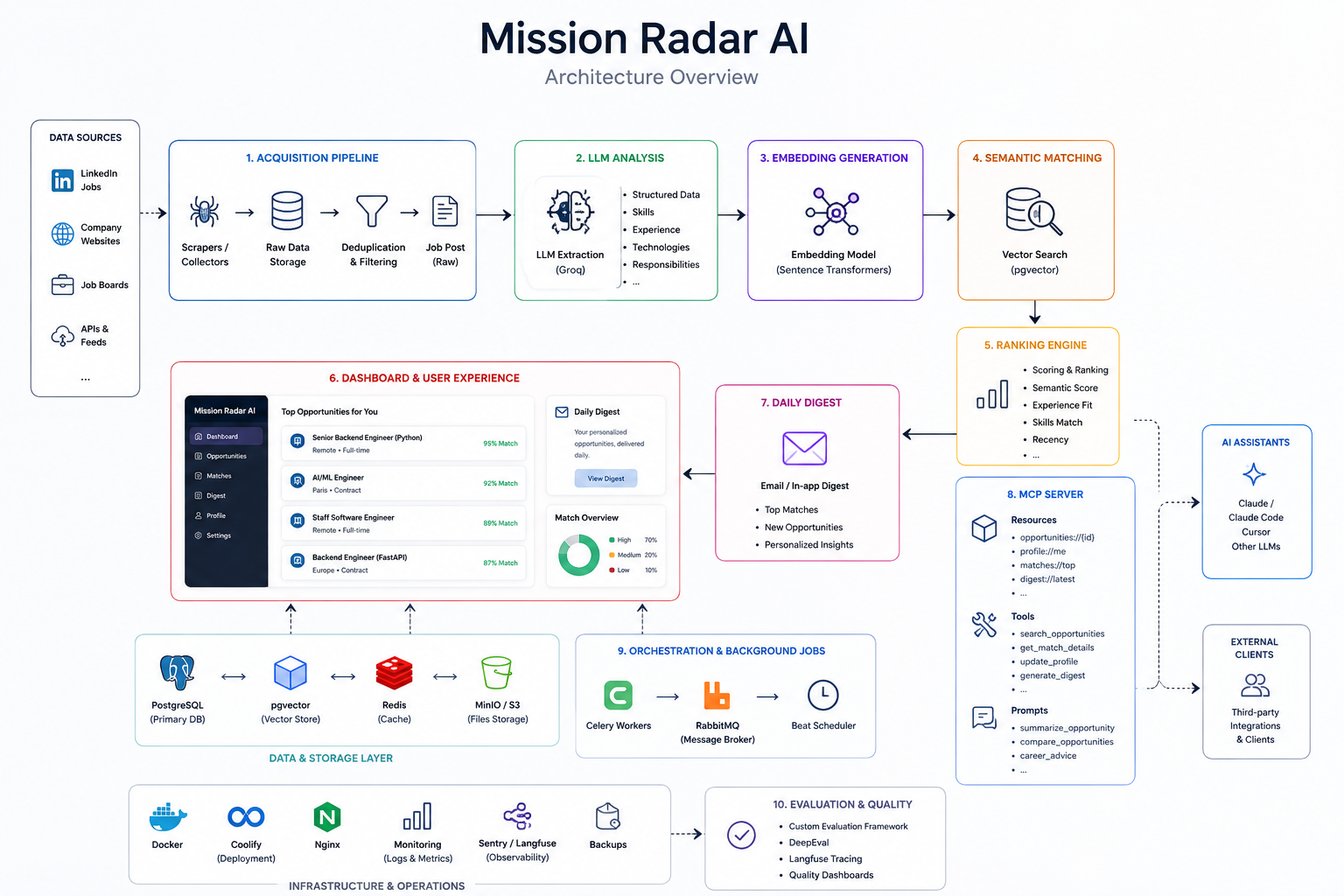

Technology Stack

Backend

  • Python
  • FastAPI
  • SQLAlchemy
  • PostgreSQL
  • pgvector

AI

  • Groq
  • Sentence Transformers
  • Embeddings
  • Semantic Search

Orchestration

  • Celery
  • RabbitMQ
  • Redis

Architecture

  • Clean Architecture
  • DDD
  • Repository Pattern
  • CQRS-inspired use cases

Authentication

  • Auth0
  • JWT
  • MCP Identity Resolution

Frontend

  • React
  • TypeScript

Infrastructure

  • Docker
  • Coolify

Evaluation

  • Custom Evaluation Framework
  • DeepEval
  • Langfuse

Key Engineering Decisions

Quelques décisions qui montrent ton niveau d’architecture :

Clean Architecture

The AI pipeline is completely isolated from infrastructure concerns, allowing every use case to be tested independently.


Asynchronous Processing

Long-running tasks such as data collection, LLM analysis and semantic matching are executed through Celery workers, preventing blocking API requests.


Identity as a Business Concern

Instead of exposing infrastructure identities throughout the application, Auth0 JWTs are translated into business identities before entering the application layer.


MCP Integration

Mission Radar exposes Resources, Tools and Prompt Templates through the Model Context Protocol, allowing AI assistants such as Claude Code to interact with the platform safely.


Evaluation First

LLM outputs are benchmarked using an internal evaluation framework combined with DeepEval to measure extraction quality and detect regressions.


Engineering Challenges Solved

  • Continuous acquisition pipeline
  • Semantic matching
  • Structured extraction from unstructured posts
  • Duplicate detection
  • Pipeline orchestration
  • Authentication for MCP
  • AI evaluation
  • Distributed processing
  • Daily digest generation
  • Vector search

Production Features

  • Multi-user
  • JWT authentication
  • Background workers
  • Retry policies
  • Dockerized deployment
  • API separation
  • React dashboard
  • MCP server
  • Evaluation framework
  • Observability ready

What I Learned

Building production AI systems is far more about software engineering than prompt engineering.

Reliable AI applications require orchestration, evaluation, architecture, authentication, asynchronous processing and monitoring just as much as they require language models.
AI Evaluation Lab

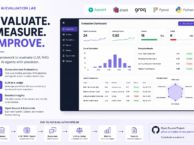
Faithfulness, answer relevancy, context precision, context recall

View More

AI Evaluation Lab

AI /

Project
AI Evaluation Lab
Repository
github.com/salletti/ai-evaluation-lab
Delivered
May 2026

Executive Summary

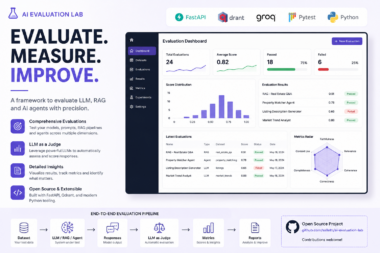
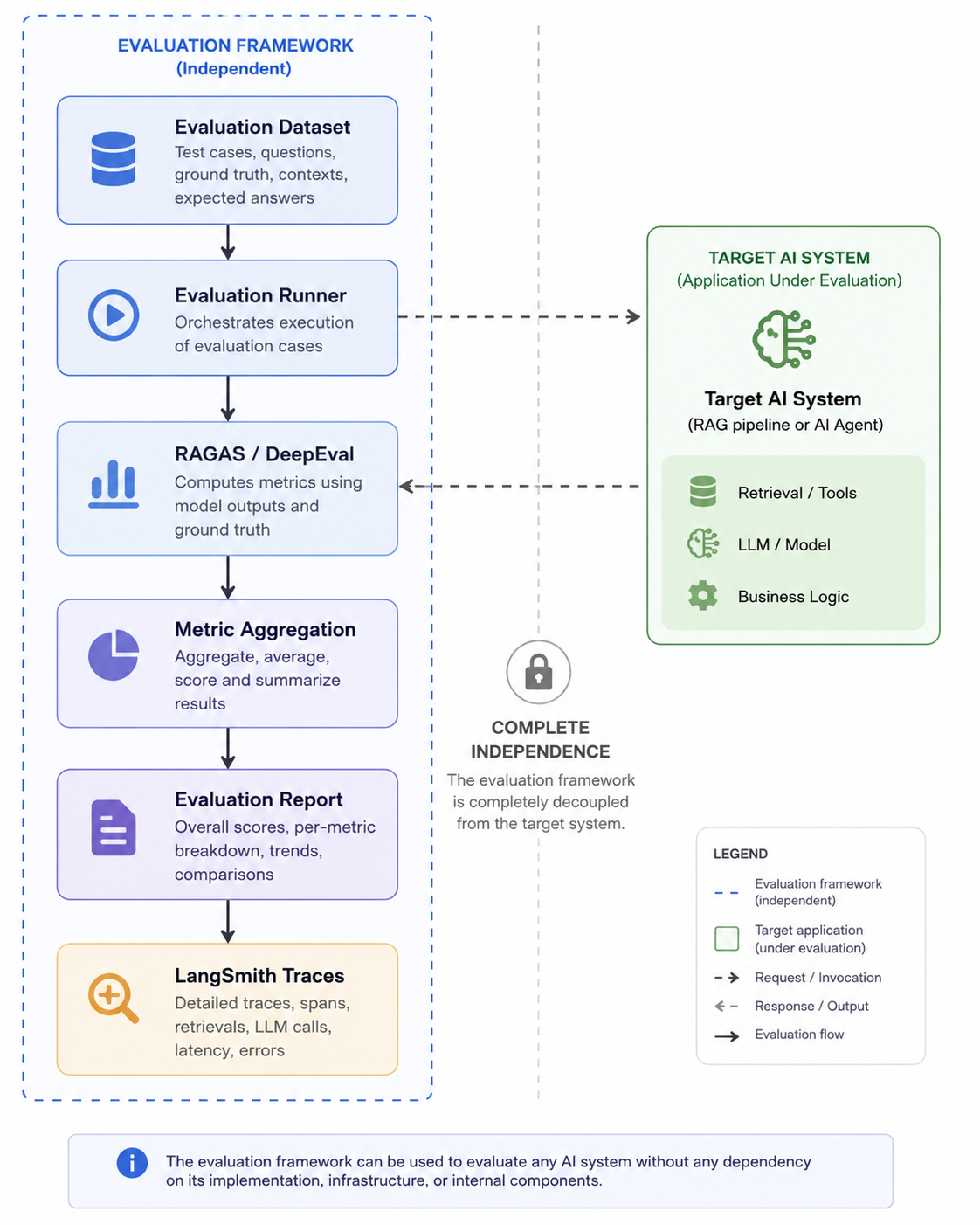
AI Evaluation Lab is an independent evaluation framework designed to benchmark RAG pipelines and AI agents using reproducible datasets and automated quality metrics.

Rather than relying on subjective manual reviews, it transforms LLM outputs into measurable engineering signals that can be compared across prompt, retrieval and model iterations.

Because the evaluation engine is completely decoupled from the application under evaluation, the same benchmark can be reused across different AI systems, making evaluation reproducible, comparable and suitable for continuous integration workflows.


Problem

Evaluating LLM applications remains one of the biggest challenges in production AI. Manual reviews are slow, subjective and difficult to reproduce, making it almost impossible to detect quality regressions as prompts, retrieval pipelines or models evolve.

Unlike traditional software, where tests produce deterministic pass/fail results, LLM applications require evaluating probabilistic outputs across multiple quality dimensions such as factual accuracy, relevance and context utilization. Without a structured evaluation process, regressions often remain invisible until they affect end users.


Why This Problem Matters

As AI applications become increasingly integrated into production systems, prompt engineering, retrieval strategies and model upgrades become part of the software lifecycle.

Without automated evaluation, every change introduces uncertainty:

  • Did answer quality improve or degrade?
  • Is the new retrieval strategy actually better?
  • Is the new model worth the additional cost?
  • Are regressions acceptable or blocking?

Reliable evaluation becomes an engineering requirement rather than a research exercise. It becomes the foundation for safely evolving AI systems over time.


System Architecture

The evaluation framework is intentionally designed as a standalone system rather than a component embedded inside the application being evaluated.

This separation makes the same benchmark reusable across multiple AI systems without modifying evaluation logic.


Technology Stack

  • Python
  • FastAPI
  • RAGAS
  • DeepEval
  • LangSmith

Key Engineering Decisions

Standalone Evaluation Framework

Designed the evaluation engine as an independent framework rather than embedding evaluation directly into the application.

This architectural decision allows the same benchmark to evaluate multiple RAG pipelines or AI agents without coupling evaluation logic to business logic, making benchmarks reusable across projects.

Complete Separation of Concerns

The framework only interacts with the public interface of the application under evaluation.

It has no dependency on the application’s internal implementation, business logic, infrastructure or deployment model.

This architectural boundary makes the evaluation engine reusable across heterogeneous AI systems while preserving complete implementation independence.


Framework-Agnostic Evaluation

Instead of relying on a single evaluation framework, the system integrates both RAGAS and DeepEval.

Each framework evaluates different quality dimensions and exposes different trade-offs. Supporting multiple evaluators makes benchmarking more comprehensive while reducing dependency on a single evaluation methodology.


Reproducible Benchmarks

Evaluation datasets are treated as reusable engineering artifacts rather than ad-hoc test cases.

Running the same benchmark repeatedly makes it possible to compare prompt iterations, retrieval strategies and model versions under identical conditions.


Evaluation Methodology

Each benchmark executes the same evaluation dataset against the target AI system.

For every evaluation case, the framework collects the generated response and computes multiple complementary quality metrics including:

  • Faithfulness
  • Answer Relevancy
  • Context Precision
  • Context Recall
  • Hallucination Rate

The resulting metrics provide a quantitative view of answer quality, making it possible to detect regressions that would be difficult to identify through manual inspection alone.


Trade-offs

LLM evaluation is inherently probabilistic.

Using LLMs as judges provides richer semantic evaluation than deterministic rules, but introduces variability between evaluation runs.

Rather than eliminating this uncertainty, the framework embraces it by combining multiple metrics and treating evaluation results as engineering signals rather than absolute truth.

For this reason, evaluation should be interpreted as statistical evidence rather than deterministic truth.


Production Considerations

The framework was designed with production evaluation workflows in mind.

Key design goals include:

  • reproducible benchmark execution;
  • reusable evaluation datasets;
  • framework-independent architecture;
  • support for automated regression testing;
  • observability through LangSmith traces.

These characteristics make the framework suitable for integration into CI/CD pipelines as AI applications evolve.

The framework was designed to integrate naturally into engineering workflows rather than remaining a standalone experimentation tool.


Results

The framework transforms subjective LLM outputs into measurable quality metrics, enabling engineering teams to compare prompt iterations, retrieval strategies and model versions using reproducible benchmarks instead of manual reviews.

Rather than answering the question:

« Does this response look better? »

the framework enables teams to answer:

« Did the system actually improve? »


Metrics Tracked

  • Faithfulness
  • Answer Relevancy
  • Context Precision
  • Context Recall
  • Hallucination Rate

What I Learned

Building this framework fundamentally changed the way I think about LLM evaluation.

Traditional software testing assumes deterministic behavior: the same input should always produce the same output. LLM applications challenge that assumption. In practice, the evaluator itself is another language model with its own biases, limitations and uncertainty.

This experience reinforced an important lesson: evaluation scores should not be treated as absolute truth, but as engineering signals that help guide better decisions. Designing reliable AI systems therefore requires not only measuring model quality, but also understanding the limitations of the measurement process itself.


Design Principles

  • Framework-independent
  • Reproducible by default
  • Evaluation as code
  • Observable execution
  • Reusable datasets
  • Metric-driven decisions

Future Directions

  • Human-in-the-loop evaluation workflows.
  • Cost-aware benchmark comparison.
  • Versioned evaluation datasets.
  • Additional evaluation frameworks.
  • Historical benchmark dashboards.
  • Continuous evaluation integrated into CI/CD.


Real Estate Markting Agent

LangGraph-powered AI agent for generating, approving, and publishing real estate marketing content across social media.

View More

Real Estate Markting Agent

AI /

Project
Real estate marketing agent
Repository
https://github.com/salletti/real-estate-marketing-agent
Delivered
June 2026

Executive Summary

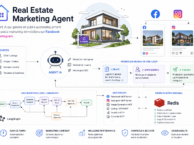
Real Estate Marketing Agent is a production-grade AI workflow that transforms real estate listings into ready-to-publish social media campaigns.

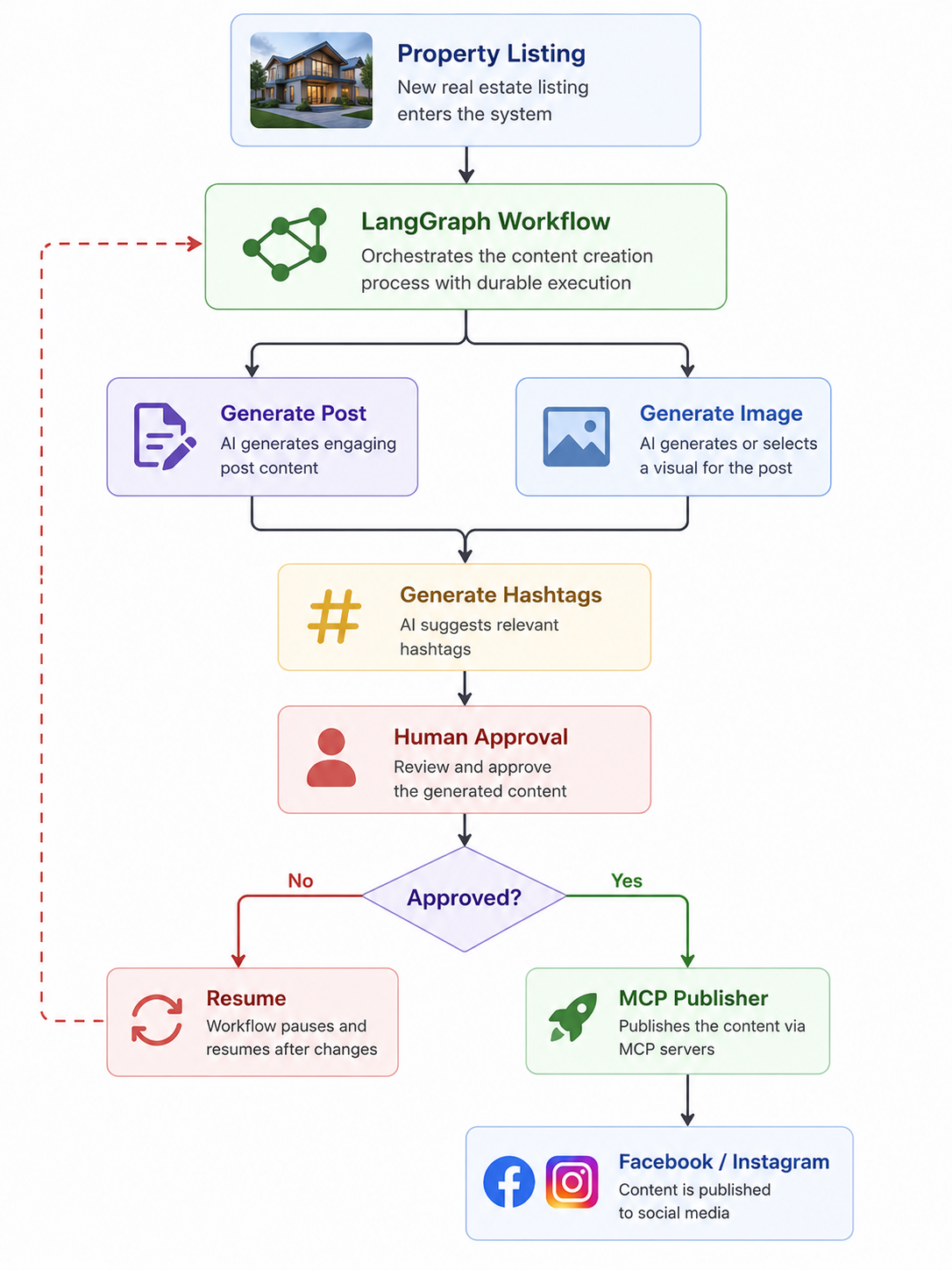
Rather than relying on a single LLM call, the system orchestrates multiple AI tasks through a durable LangGraph workflow, pauses for human approval, and resumes execution automatically before publishing content through MCP servers.

The project explores how modern AI agents should be engineered when reliability, observability and human oversight become first-class architectural concerns rather than afterthoughts.


Engineering Challenges Solved

  • Human-in-the-Loop Workflows
  • Long-Running AI Execution
  • Durable State Persistence
  • AI Workflow Orchestration
  • MCP Tool Integration
  • Runtime Capability Discovery
  • Structured AI Outputs
  • Production Observability

Problem

Real estate agencies spend hours creating marketing content for listings and social media. The process is repetitive, difficult to scale and still requires human validation before anything can be published.

While generating text with an LLM is relatively straightforward, production workflows introduce a very different class of engineering problems. AI-generated content must coordinate multiple generation steps, interact with external systems, pause for asynchronous human approval and recover safely after interruptions.

Traditional request-response architectures are not designed for these long-running workflows.


Why This Problem Matters

Most AI demonstrations stop after a successful prompt.

Production AI systems rarely do.

Real-world workflows span multiple services, involve asynchronous human decisions, depend on external APIs and must remain recoverable after failures or process restarts.

The challenge therefore shifts from prompt engineering to workflow orchestration, state management and software architecture.


System Architecture


Technology Stack

Python

FastAPI

LangGraph

Redis

MCP

OpenAI

LangSmith

Docker


Key Engineering Decisions

Human-in-the-Loop Instead of Fully Autonomous Publishing

Publishing automatically would maximize throughput but also increase operational risk.

The workflow deliberately pauses before publication, allowing a human to validate every generated campaign before execution resumes.

This design prioritizes trust and editorial control over complete automation.


Durable Execution Instead of Request-Response Processing

Marketing campaigns cannot assume that approval happens within seconds.

The workflow therefore uses LangGraph’s durable execution model combined with Redis checkpoints, allowing execution to pause indefinitely and resume later from exactly the same state.

This transforms the agent into a resilient long-running workflow rather than a simple API request.


Runtime Capability Discovery Through MCP

Rather than hardcoding external integrations, the backend dynamically discovers the capabilities exposed by connected MCP servers during application startup.

This architecture decouples workflow orchestration from implementation details while making new capabilities extensible without modifying business logic.


Clean Architecture for AI Systems

The project follows Clean Architecture principles throughout the codebase.

Business rules remain isolated from LLM providers, MCP servers and infrastructure concerns, allowing AI capabilities to evolve without impacting the domain model or application layer.

This keeps the system testable, maintainable and adaptable to future models or protocols.


Workflow Orchestration

Instead of treating AI generation as a single prompt, the workflow decomposes the problem into specialized stages responsible for content generation, aggregation, approval and publication.

LangGraph coordinates state transitions while Redis preserves execution context across interruptions.

The result is an AI workflow that behaves more like a distributed application than a traditional chatbot.


Trade-offs

Introducing mandatory human approval inevitably reduces automation throughput.

However, it dramatically improves reliability, prevents unintended publications and keeps human operators accountable for final decisions.

Similarly, durable execution increases implementation complexity but enables workflows that can safely span minutes, hours or even days without losing state.


Production Considerations

The system was designed with production deployment as a primary objective.

Key architectural concerns include:

  • durable execution;
  • Redis-backed workflow persistence;
  • structured outputs between workflow nodes;
  • retry mechanisms;
  • runtime capability discovery;
  • distributed correlation IDs;
  • end-to-end observability through LangSmith;
  • separation between orchestration and infrastructure.

These decisions ensure that workflow reliability does not depend on a single process remaining alive.


Results

The project demonstrates how AI agents evolve into production systems once orchestration, persistence and external integrations become part of the architecture.

Instead of generating isolated responses, the workflow coordinates content generation, human validation and automated publication while remaining observable, resumable and resilient to interruptions.


Metrics Tracked

  • Workflow Execution Time
  • Human Approval Latency
  • Node Execution Duration
  • Publication Success Rate
  • Retry Count
  • Workflow Recovery Success
  • Durable State Persistence
  • End-to-End Trace Correlation

What I Learned

Building an AI agent is relatively straightforward.

Building one that can safely pause, survive process restarts, coordinate external tools, wait for asynchronous human decisions and resume execution reliably is fundamentally a distributed systems problem.

This project reinforced the idea that production AI systems are defined less by the intelligence of their models than by the robustness of the software architecture orchestrating them.


Future Directions

  • Multi-agent collaboration
  • Additional social media platforms
  • Automatic campaign evaluation
  • Cost-aware workflow optimization
  • Scheduling and campaign planning
  • Human feedback learning loops
  • Advanced operational dashboards

Real Estate semantic search engine

A production-grade AI retrieval engine combining structured filters, semantic search and intelligent query planning to return the most relevant properties for every search.

View More

Real Estate semantic search engine

AI /

Project
Semantic search Engine
Repository
github.com/salletti/real-estate-semantic-search
Url
https://semantic-search.stefanoalletti.com/

Executive Summary

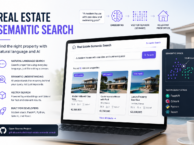
Real Estate Semantic Search is a production-grade AI retrieval engine designed to bridge the gap between structured databases and semantic search.

Rather than relying exclusively on vector search, the system combines deterministic NLP, structured filtering, semantic retrieval and hybrid ranking inside a modular query engine capable of selecting the most appropriate retrieval strategy for every user request.

The project explores how modern AI retrieval systems should balance precision, explainability and semantic understanding instead of treating vector search as a universal solution.


Engineering Challenges Solved

  • Semantic Retrieval
  • Hybrid Search
  • Query Planning
  • Natural Language Parsing
  • Vector Databases
  • Retrieval Strategy Selection
  • Clean Architecture
  • Production Retrieval Pipelines

Problem

Traditional keyword search fails whenever users describe the same concept using different words.

Vector databases solve part of this problem by retrieving semantically similar documents, but they introduce another challenge: semantic similarity alone is insufficient for production search systems.

Real-world queries often combine structured constraints, qualitative descriptions and geographical requirements, requiring multiple retrieval strategies to work together instead of competing.


Why This Problem Matters

Modern AI applications depend on reliable retrieval.

Retrieval-Augmented Generation (RAG), AI agents and enterprise search systems all rely on the ability to retrieve the right information before any language model can generate useful responses.

Choosing the wrong retrieval strategy directly impacts answer quality, latency and user trust.

Building an effective retrieval engine therefore becomes an architectural problem rather than simply selecting a vector database.


System Architecture


Technology Stack

  • Python
  • FastAPI
  • PostgreSQL
  • Qdrant
  • Sentence Transformers
  • Docker
  • React

Key Engineering Decisions

Query Planning Before Retrieval

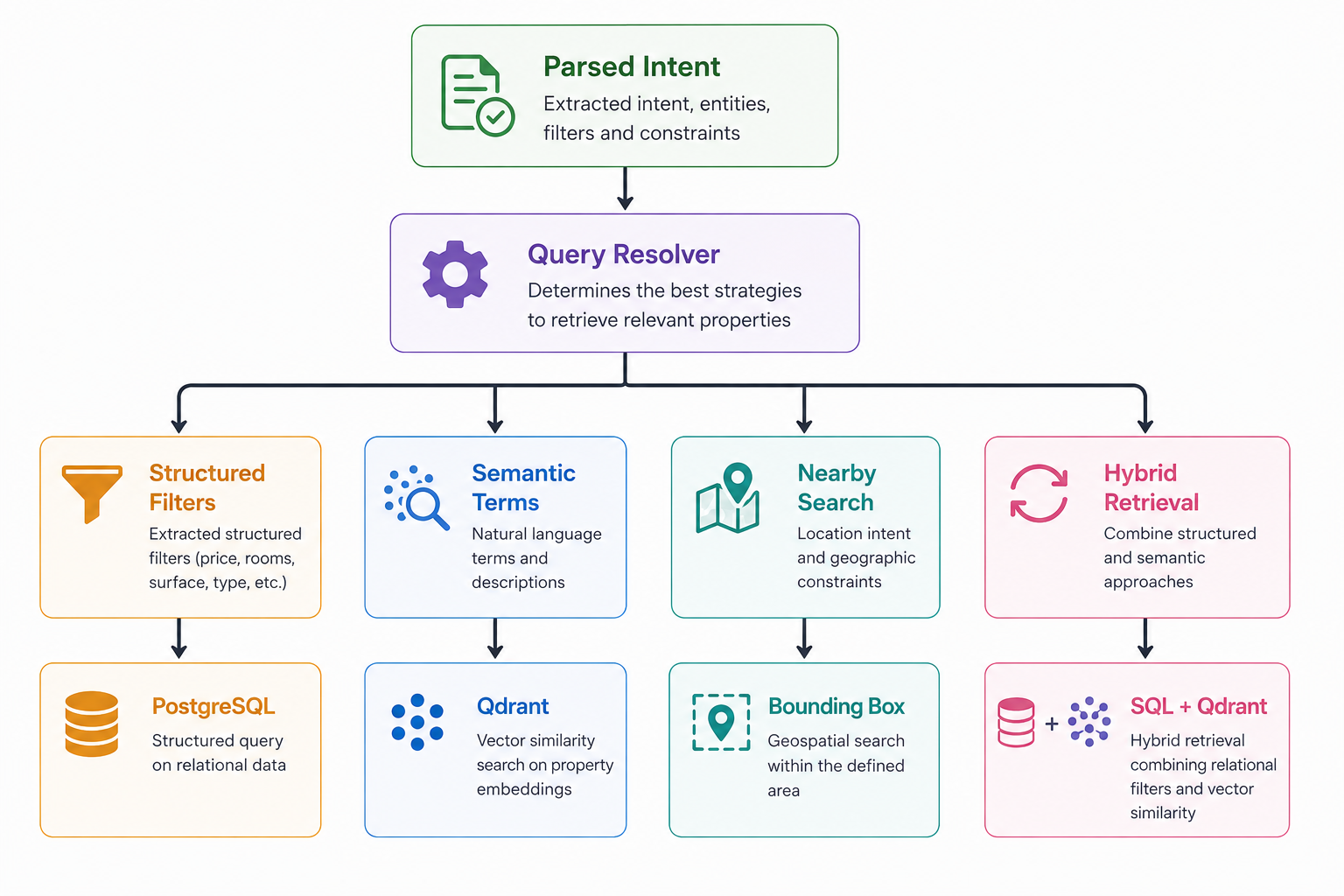
Rather than sending every request directly to a vector database, the system first analyzes user intent and determines which retrieval strategy best matches the query.

This keeps structured searches fast while reserving semantic search for cases where it genuinely improves relevance.


PostgreSQL Remains the Source of Truth

Instead of duplicating the complete business model inside the vector database, PostgreSQL remains responsible for structured data while Qdrant acts purely as a semantic index.

This separation simplifies maintenance and avoids synchronization issues between business data and embeddings.


Hybrid Retrieval Instead of Vector-Only Search

Semantic similarity alone cannot enforce hard business constraints such as price, location or property type.

The retrieval engine therefore combines SQL filtering with semantic ranking, ensuring that retrieved properties satisfy structured requirements before being ordered by semantic relevance.


Clean Architecture Around Retrieval

The retrieval pipeline follows Clean Architecture principles.

Intent parsing, query planning, retrieval and infrastructure remain isolated through well-defined interfaces, allowing individual components to evolve independently.


Retrieval Pipeline

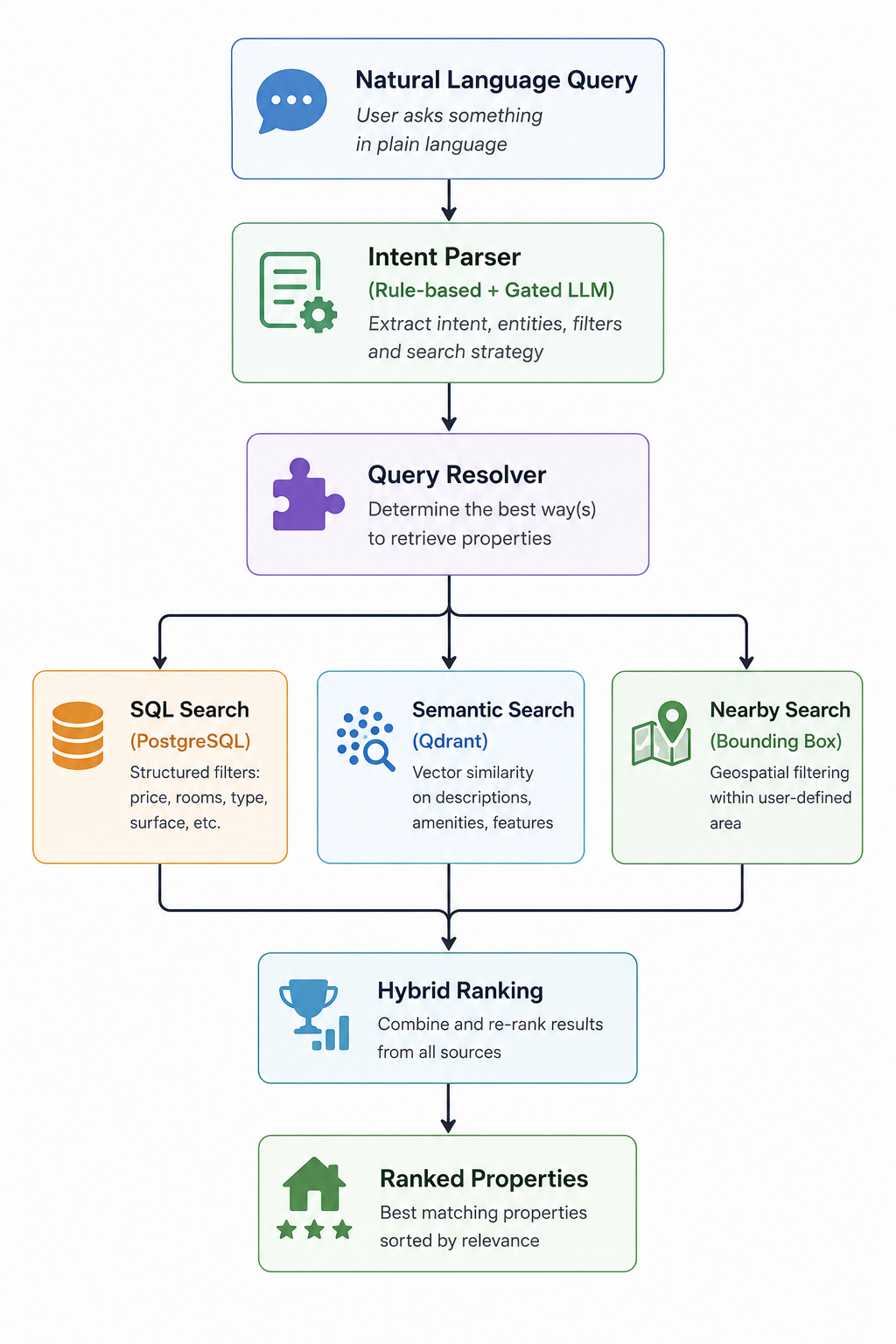
Instead of directly embedding every user query, the system decomposes retrieval into several independent stages.

Natural language is first converted into a structured intent.

The Query Resolver then determines whether SQL, semantic search, nearby search or a hybrid strategy should be executed.

Only after this planning phase does the retrieval engine interact with PostgreSQL and Qdrant.

This architecture keeps retrieval deterministic, explainable and extensible.


Trade-offs

Using vector search for every request simplifies implementation but sacrifices precision for structured filters.

Conversely, relying exclusively on SQL prevents semantic understanding.

The chosen architecture intentionally accepts additional orchestration complexity in exchange for better explainability, lower retrieval costs and higher relevance across different query types.


Production Considerations

The retrieval engine was designed with production systems in mind.

Key architectural concerns include:

  • deterministic query planning;
  • modular retrieval strategies;
  • semantic indexing;
  • hybrid ranking;
  • explainable routing decisions;
  • vector database abstraction;
  • clean separation between domain and infrastructure;
  • independently testable retrieval components.

Results

The project demonstrates that semantic retrieval is only one component of a modern retrieval engine.

By combining structured filtering, semantic similarity and intelligent query routing, the system returns relevant results even when user queries share little or no lexical overlap with indexed documents while preserving the precision required by business constraints.


Metrics Tracked

  • Retrieval Precision@K
  • Embedding Latency
  • Retrieval Latency
  • Strategy Distribution (SQL / Semantic / Hybrid)
  • Query Resolution Accuracy

What I Learned

Building a semantic search engine is not primarily about choosing the best embedding model or vector database.

The real challenge lies in deciding when semantic retrieval should be used, when deterministic search is sufficient and how both approaches can cooperate inside the same retrieval architecture.

This project fundamentally changed how I think about RAG systems: retrieval quality depends as much on query planning as on embedding quality.


Future Directions

  • Adaptive retrieval strategy selection
  • Payload filtering inside Qdrant
  • Retrieval reranking models
  • Multi-vector search
  • Cross-encoder reranking
  • Retrieval evaluation benchmarks
  • Agent-driven retrieval planning

Je rajouterais un deuxième diagramme

Celui-ci est, à mon avis, le plus intéressant du projet.

Juste après Key Engineering Decisions.

Query Strategy Selection

Days on market — real estate time-to-sell predictor

Prediction of a property’s time on market — a full-stack application powered by Machine Learning.

View More

Days on market — real estate time-to-sell predictor

AI /

Project
Days on market — real estate time-to-sell predictor
Repository
https://github.com/salletti/real-estate-ml-days-on-market
Url
https://days-on-market.stefanoalletti.com

Executive Summary

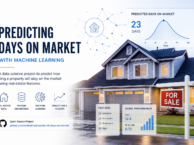
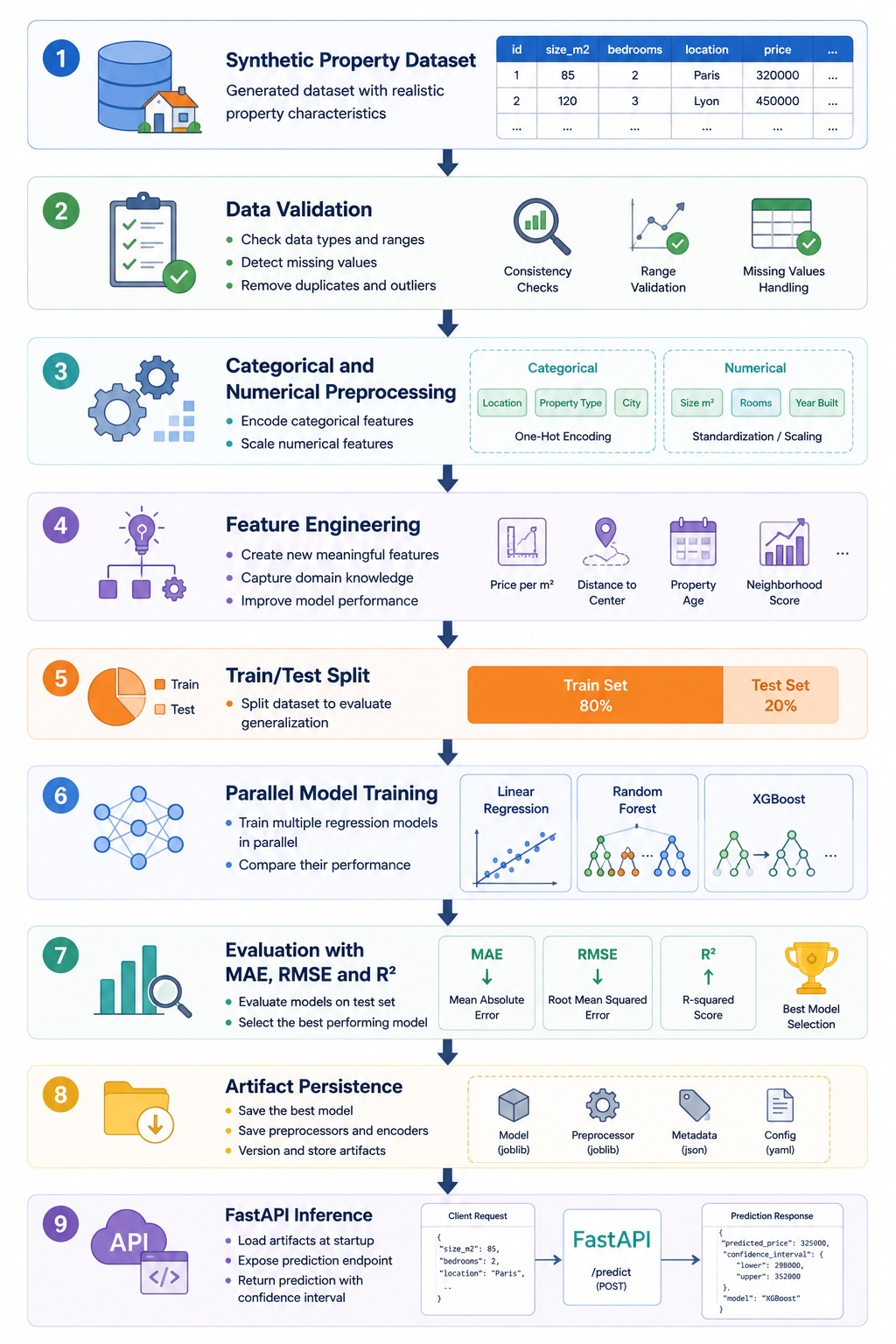
Days on Market is a production-oriented machine learning system designed to estimate how long a real estate property may remain on the market before being sold.

Rather than presenting a single opaque prediction, the application compares three regression models, exposes confidence ranges and highlights the influence of pricing through a carefully engineered market-position feature.

The project explores how predictive machine learning systems should be designed when interpretability, uncertainty and feature engineering matter more than model complexity.

Engineering Challenges Solved

  • Predictive Machine Learning
  • Feature Engineering
  • Regression Model Comparison
  • Uncertainty Estimation
  • Reproducible Training Pipelines
  • Structured Data Preprocessing
  • Model Serving
  • Production ML API

Problem

Estimating how long a property will remain on the market is difficult because selling time depends on many interacting factors, including price, location, surface area, energy performance and property condition.

Agents often rely on experience and local intuition, but these estimates can be inconsistent and difficult to justify.

A useful predictive system must therefore do more than output a number. It must identify the variables that truly drive the prediction, communicate uncertainty and remain understandable enough to support human decision-making.

Why This Problem Matters

Predictive models influence pricing, marketing strategy and seller expectations.

An inaccurate estimate can lead to unrealistic promises, inappropriate listing prices or poor commercial decisions.

The engineering challenge is therefore not simply to optimize a regression metric, but to build a reproducible and interpretable decision-support system that communicates both predictions and their limitations.

System Architecture

Technology Stack

  • Python
  • FastAPI
  • scikit-learn
  • XGBoost
  • Pandas
  • Pydantic
  • React
  • TypeScript
  • Docker

Key Engineering Decisions

Feature Engineering Before Model Complexity

The most influential feature in the project is not a raw property attribute, but a derived pricing ratio comparing the listing price with the estimated local market value:

listing_price / (surface × market_price_per_m²)

This feature captures whether a property is positioned above or below its local market.

Once introduced, even linear regression reached performance close to more complex tree-based models.

This demonstrated that representing the problem correctly can matter more than selecting a more sophisticated algorithm.

Compare Multiple Models Instead of Selecting One Too Early

The application trains and exposes Linear Regression, Random Forest and XGBoost using the same dataset and preprocessing assumptions.

Rather than treating the most complex model as the default winner, the system compares their MAE, RMSE and R² values.

This makes model selection evidence-based and reveals whether additional complexity produces a meaningful operational benefit.

Expose Uncertainty Instead of a False Exact Answer

A prediction such as “47 days” may appear precise while hiding substantial uncertainty.

The application therefore returns a lower and upper estimate alongside the central prediction.

This turns the output into a decision-support signal rather than an artificial guarantee and provides users with a more realistic representation of model confidence.

Keep Training and Inference Separate

Model training is executed through a dedicated pipeline that performs preprocessing, fitting, evaluation and artifact persistence.

The production API loads previously trained model artifacts and performs inference only.

This separation avoids retraining during application startup, improves reproducibility and keeps production behavior predictable.

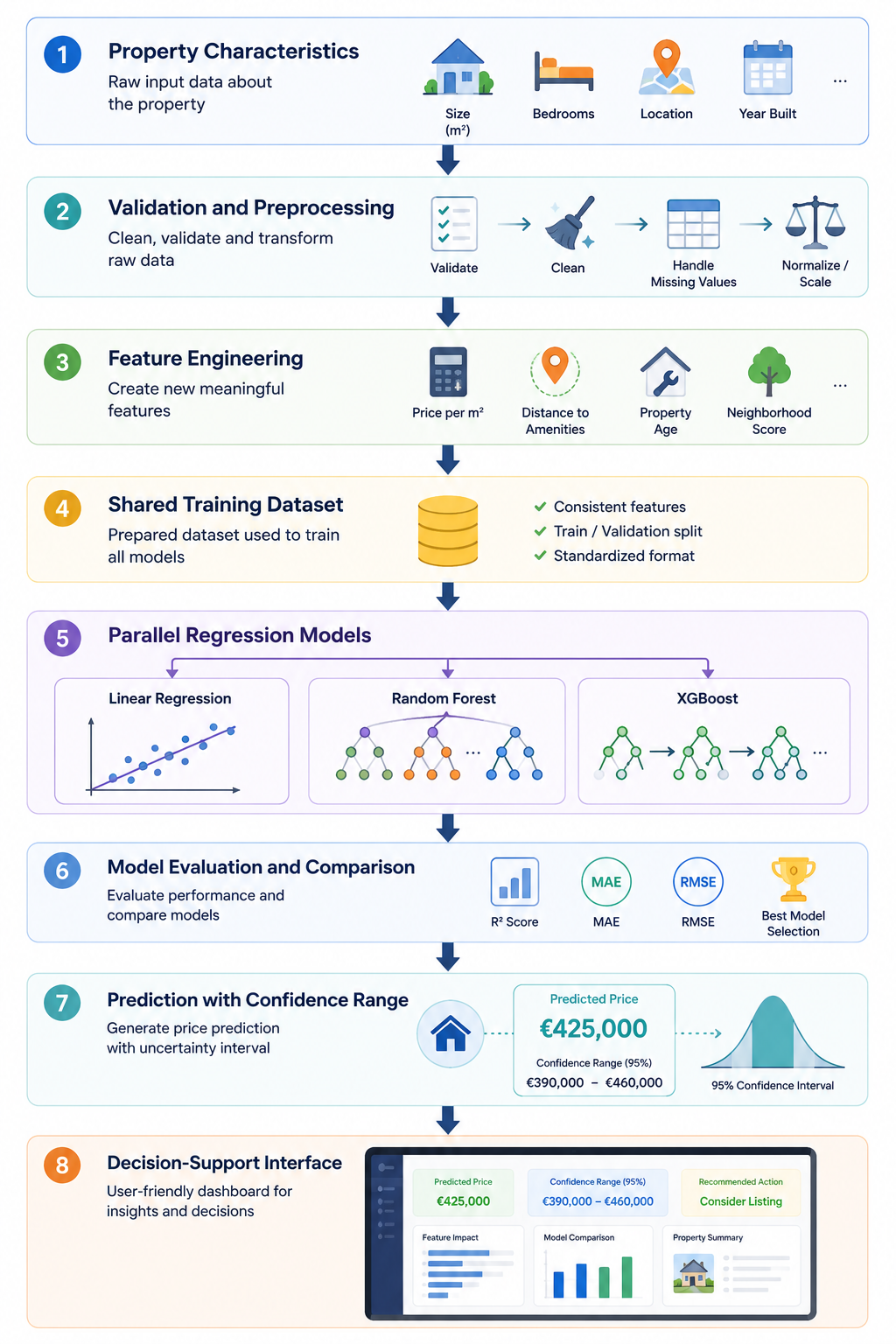
Machine Learning Pipeline

The project separates the machine learning lifecycle into distinct stages:

All models receive a consistent representation of the data, making their performance directly comparable.

The application then serves either one selected model or all three models in parallel, allowing users to compare their predictions and associated metrics.

Trade-offs

The synthetic dataset provides complete control over data generation and makes experimentation reproducible.

However, synthetic relationships are necessarily simpler than real property markets and may not reproduce geographic variation, economic cycles or behavioral effects.

Comparing three models also increases training and maintenance complexity, but provides a clearer understanding of whether model sophistication creates measurable value.

Finally, confidence ranges improve communication, but they should not be interpreted as formally calibrated guarantees without stronger statistical validation.

Production Considerations

The system was designed with a clear separation between experimentation and serving.

Key architectural concerns include:

  • reproducible preprocessing;
  • persisted model artifacts;
  • shared feature definitions between training and inference;
  • typed API contracts;
  • application-level model comparison;
  • health checks exposing model availability;
  • automated linting and type checking;
  • containerized deployment;
  • isolated training commands;
  • prevention of preprocessing drift.

These decisions reduce the risk of producing different feature representations during training and production inference.

Results

The three models achieved similar performance on the synthetic dataset, with an MAE of approximately eight days and an R² close to 0.89.

The most important result was not that XGBoost outperformed the alternatives, but that Linear Regression became similarly effective after introducing the pricing-ratio feature.

This showed that the structure and quality of the input representation had a greater impact than model complexity in this problem.

Metrics Tracked

  • Mean Absolute Error
  • Root Mean Squared Error
  • R² Score
  • Prediction Interval Width
  • Training Duration
  • Inference Latency
  • Model Agreement
  • Error Distribution
  • Feature Importance
  • API Response Time

What I Learned

The choice of model is often less important than the way the problem is represented.

Before introducing the derived pricing-ratio feature, the models had to infer the relationship between price, surface and local market conditions independently. Once that relationship was explicitly encoded, even a simple linear model performed competitively with XGBoost.

This project reinforced the idea that feature engineering, data quality and evaluation design frequently create more value than increasing model complexity.

It also highlighted the importance of communicating uncertainty: a useful machine learning system should support human judgment rather than present probabilistic estimates as certain outcomes.

Future Directions

  • Training with real DVF and listing data
  • Temporal validation across market periods
  • Geographic cross-validation
  • Hyperparameter optimization
  • Explainability with SHAP
  • Calibrated prediction intervals
  • Drift detection
  • Automated retraining
  • Feature store integration
  • Market-segment-specific models

Real estate photo quality detector

Computer Vision API for real estate photo quality assessment.

View More

Real estate photo quality detector

AI /

Project
Real estate photo quality detector
Repository
https://github.com/salletti/real-estate-photo-quality
URL
https://photo-quality.stefanoalletti.com/
Delivered
April 2026

Executive Summary

Real Estate Photo Quality Assessment is a production-oriented computer vision system designed to automatically evaluate the visual quality of real estate photographs before publication.

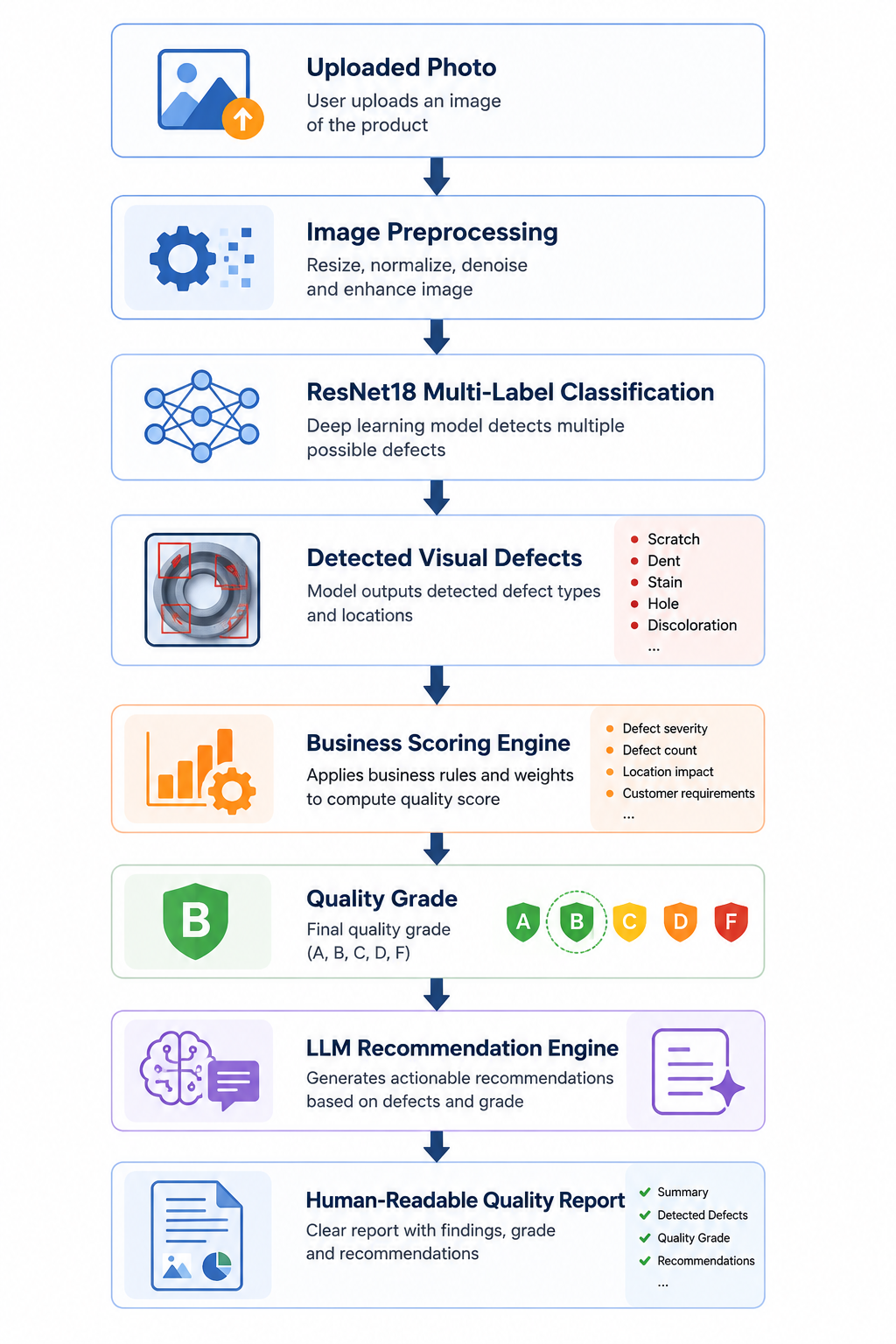
Rather than relying solely on image classification, the application combines multi-label defect detection, deterministic business scoring and LLM-generated recommendations to transform raw predictions into actionable quality reports for real estate professionals.

The project explores how computer vision models can be integrated into production systems where explainability, maintainability and business rules are as important as model accuracy.


Engineering Challenges Solved

  • Computer Vision Pipeline
  • Multi-Label Classification
  • Dataset Engineering
  • Synthetic Data Generation
  • Transfer Learning
  • Business Rule Scoring
  • Explainable AI Outputs
  • Production Inference API

Problem

The quality of property photos has a direct impact on buyer engagement and listing performance. However, reviewing thousands of images manually is subjective, inconsistent and difficult to scale.

While detecting visual defects with a neural network is relatively straightforward, production systems require much more than image classification. Predictions must be translated into meaningful business decisions, remain explainable to users and generate actionable feedback instead of raw probabilities.

Building such a system requires combining computer vision, deterministic business logic and natural language generation into a single production pipeline.


Why This Problem Matters

Computer vision models rarely operate in isolation.

Real-world applications require reliable data pipelines, reproducible training processes, explainable predictions and business rules that evolve independently from machine learning models.

The challenge therefore shifts from training a classifier to engineering an end-to-end system capable of producing trustworthy and actionable results.


System Architecture


Technology Stack

  • Python
  • FastAPI
  • PyTorch
  • TorchVision
  • Pillow
  • Groq (Llama 3.3)
  • Docker
  • React

Key Engineering Decisions

Separate Detection from Business Decisions

The computer vision model is responsible only for detecting visual defects.

Quality scoring is intentionally implemented as a deterministic business layer, allowing scoring policies to evolve independently from model training.

This separation improves explainability while keeping business rules transparent, testable and easy to evolve.


Engineer the Dataset Instead of Waiting for Data

Building supervised vision systems requires annotated datasets that are often unavailable.

To accelerate experimentation, the project includes a synthetic dataset generation pipeline capable of automatically applying realistic visual defects such as blur, poor lighting and framing issues to clean property images.

This approach enables reproducible training while significantly reducing manual annotation effort.


Favor Simplicity Over Model Complexity

Given the relatively small dataset, the objective was not to maximize model size but to maximize generalization.

A lightweight transfer-learning approach based on ResNet18 provides an effective balance between inference speed, training efficiency and overfitting risk compared with significantly larger architectures.


Combine Computer Vision with Natural Language Feedback

Raw predictions are difficult for end users to interpret.

Instead of exposing probabilities, detected issues are converted into structured quality scores before being passed to an LLM that generates concise improvement recommendations.

This architecture transforms technical model outputs into practical guidance without coupling business logic to the language model.


Computer Vision Pipeline

Rather than treating image quality assessment as a single prediction task, the application decomposes the workflow into specialized stages responsible for image preprocessing, defect detection, deterministic scoring and recommendation generation.

Machine learning remains focused on perception, while business rules and LLMs handle interpretation and communication.

The result is a modular pipeline where each component can evolve independently without impacting the others.


Trade-offs

Synthetic dataset generation accelerates experimentation and enables reproducible annotations, but it cannot fully reproduce the variability of real-world photography.

Similarly, deterministic business scoring sacrifices some flexibility compared with end-to-end learned scoring, yet provides complete explainability, easier maintenance and greater control over quality policies.


Production Considerations

The system was designed with production deployment as a primary objective.

Key architectural concerns include:

  • transfer learning for efficient training;
  • deterministic business scoring;
  • synthetic dataset generation;
  • reproducible preprocessing pipeline;
  • model inference through FastAPI;
  • LLM-powered recommendation generation;
  • separation between machine learning and business logic;
  • containerized deployment with Docker.

These decisions ensure that model evolution remains independent from application behavior while keeping predictions transparent and maintainable.


Results

The project demonstrates how computer vision models become production systems once dataset engineering, inference pipelines, business rules and user-facing recommendations are integrated into the architecture.

Rather than producing isolated predictions, the application delivers complete quality assessments that combine visual defect detection, objective scoring and actionable recommendations within a single workflow.


Metrics Tracked

  • Multi-Label Classification Accuracy
  • Training Loss
  • Inference Latency
  • Quality Score Distribution
  • Defect Detection Frequency
  • API Response Time
  • LLM Generation Latency
  • End-to-End Prediction Time

What I Learned

Training a computer vision model is only one part of building an AI application.

The real engineering challenge lies in designing the surrounding system: creating reliable datasets, separating perception from business logic, ensuring explainability and transforming model predictions into information that users can confidently act upon.

This project reinforced the idea that production machine learning systems are defined as much by their software architecture as by the models they deploy.


Future Directions

  • Larger real-world annotated dataset
  • Advanced data augmentation
  • Validation and early stopping
  • Context-aware room type modeling
  • Automatic room type detection
  • Model explainability with Grad-CAM
  • ONNX model optimization
  • Batch inference pipeline

Poc of Clean architecture with Symfony

A practical proof of concept showing how Symfony and Clean Architecture fit together to build framework-independent, maintainable applications with a clear separation of concerns.

View More

Poc of Clean architecture with Symfony

Symfony /

Project
Poc of Clean architecture with Symfony
Repository
https://github.com/salletti/clean-architecture-symfony-poc

Problem
Many Symfony projects become difficult to maintain as business logic is tightly coupled to the framework, making testing, evolution, and technology changes unnecessarily expensive.

Stack
PHP 8.4, Symfony 7, Doctrine ORM, PHPUnit, Docker

Key decision
Applied Clean Architecture by enforcing strict dependency inversion: the Domain and Application layers never depend on Symfony or Doctrine, while framework-specific code is isolated in Infrastructure. This makes business logic independently testable and allows technical components to be replaced with minimal impact.

Metrics tracked
Architecture dependency compliance, unit test coverage, framework-independent business logic, and use case isolation.

Result
A proof of concept demonstrating how to build framework-agnostic Symfony applications with Clean Architecture, serving as a practical foundation for scalable, maintainable enterprise software.

More projects

DDD with Symfony

A reference implementation of DDD, CQRS, and Hexagonal Architecture with Symfony, recognized by the community with nearly 200 GitHub stars. A practical template for building clean, maintainable, production-ready applications.

View More

DDD with Symfony

Symfony /

Project
Symfony DDD example
Repository
https://github.com/salletti/symfony-ddd-example/

Problem
Many Symfony applications gradually become tightly coupled, making business logic hard to test, evolve, and reuse as infrastructure concerns leak into the domain.

Stack
PHP 8.4, Symfony 7, Doctrine ORM, PostgreSQL, PHPUnit, Docker

Key decision
Organized the application around Domain-Driven Design and Clean Architecture instead of Symfony bundles or technical layers. Business rules live exclusively in the Domain, with the Application layer orchestrating use cases through ports, while Infrastructure contains only technical implementations. This keeps the domain framework-agnostic and independently testable.

Metrics tracked
Unit test coverage of the domain, architecture rule compliance, dependency direction (Infrastructure → Application → Domain), and use case execution through command/query handlers.

Result
A production-ready Symfony template demonstrating how to build maintainable, testable applications with DDD, CQRS, and Hexagonal Architecture, serving as a reference implementation for real-world business systems.

More projects

Clients

IAD

View More

IAD

Clients /

Technical Lead – Platform Team

IAD FranceJune 2025 – Present

Member of the Platform Team, responsible for strategic cross-functional initiatives and large-scale technical projects across the IAD ecosystem.

I design and deliver distributed systems while bridging business requirements, product teams and engineering. My work focuses on defining target architectures, modernizing existing platforms and building scalable solutions used across multiple countries.

Highlights

  • Designed distributed and event-driven architectures
  • Led large-scale platform modernization initiatives
  • Built AWS-based cloud integrations and backend services
  • Designed cross-platform technical solutions shared across the group
  • Collaborated with CTOs, Platform Engineers and Product teams on strategic technical decisions

Technologies

Symfony • PHP 8 • Python • AWS • Lambda • SQS • PostgreSQL • Docker • Event-Driven Architecture • API Platform


Lead Full-Stack Developer

IAD FranceJune 2023 – June 2025

Technical lead of the Advertise team, responsible for the international real estate listing platform powering IAD’s publication ecosystem.

Led the evolution of a business-critical platform by modernizing legacy applications, introducing cloud-native services and designing asynchronous architectures supporting millions of real estate listings.

Highlights

  • Led the technical roadmap of the Advertise platform
  • Modernized legacy applications with PHP 8 and Symfony
  • Designed event-driven workflows and asynchronous processing
  • Built integrations with international real estate portals
  • Developed cloud-native services using AWS Lambda
  • Participated in the introduction of AI-assisted listing generation
  • Mentored developers and drove architectural decisions

Technologies

Symfony • PHP • Node.js • AWS Lambda • SQS • PostgreSQL • RabbitMQ • Docker • API Platform • Event-Driven Architecture


Full-Stack Developer

IAD FranceJanuary 2023 – June 2023

Contributed to the development of IAD’s Candidate Portal, the platform used to onboard new real estate advisors.

Worked on both backend and frontend development while helping establish the project’s architecture and software engineering best practices.

Highlights

  • Designed REST APIs with Symfony and API Platform
  • Developed frontend features using Vue.js
  • Integrated Auth0 authentication
  • Applied Clean Architecture and Domain-Driven Design principles
  • Delivered features within an Agile environment

Technologies

Symfony • PHP • API Platform • Vue.js • Auth0 • PostgreSQL • Docker • Clean Architecture • DDD

Le Figaro

View More

Le Figaro

Clients /

Full-Stack Developer (Freelance)

Le FigaroOctober 2021 – January 2023

Worked on the editorial CMS used daily by Le Figaro’s newsrooms to create, manage and publish both digital and print content.

Contributed to the evolution of a business-critical publishing platform, developing backend APIs, React interfaces and scalable content distribution mechanisms.

Highlights

  • Developed and maintained the group’s editorial CMS
  • Built backend APIs and React-based user interfaces
  • Implemented RabbitMQ-based synchronization between distributed systems
  • Enhanced search and indexing capabilities with Elasticsearch
  • Improved platform scalability and performance for high-volume editorial workflows

Technologies

Symfony • PHP • React • RabbitMQ • Elasticsearch • REST APIs • Docker

France Télévision

View More

France Télévision

Clients /

Full-Stack Developer (Freelance)

France TélévisionsMarch 2019 – October 2021

Contributed to the modernization of france.tv, one of France’s largest digital streaming platforms, by evolving both backend and frontend architectures.

Worked on the migration to modern Symfony versions while helping introduce scalable development practices and clean architectural principles across the platform.

Highlights

  • Migrated applications to Symfony 4 and Symfony 5
  • Designed RESTful backend services using Hexagonal Architecture and Domain-Driven Design
  • Introduced Symfony Messenger and HttpClient for modern inter-service communication
  • Developed frontend applications with React and modern JavaScript (ES6)
  • Integrated UX/UI designs into performant, maintainable interfaces
  • Improved software quality through automated testing, static analysis and Docker-based development workflows

Technologies

Symfony 4/5 • PHP • React • JavaScript (ES6) • Symfony Messenger • HttpClient • REST APIs • Docker • Domain-Driven Design • Hexagonal Architecture • SOLID

L’Express

View More

L’Express

Clients /

Full-Stack Developer (Freelance)

L’ExpressApril 2017 – March 2019

Contributed to the complete redesign of lexpress.fr, delivering both backend and frontend features as part of the platform’s digital transformation and subscription strategy.

Designed scalable services and event-driven architectures supporting subscriptions, payments and user management while improving maintainability and system performance.

Highlights

  • Developed the subscription, payment and user access management platform
  • Built REST APIs with API Platform
  • Designed asynchronous workflows using Symfony Messenger and RabbitMQ
  • Applied Event Sourcing, CQRS and Hexagonal Architecture principles
  • Optimized data access and search with MongoDB and Elasticsearch
  • Developed React-based frontend applications and integrated UX/UI designs
  • Delivered full-stack features from architecture to production

Technologies

Symfony • PHP • React • API Platform • RabbitMQ • Symfony Messenger • MongoDB • Elasticsearch • Event Sourcing • CQRS • Hexagonal Architecture

Meetic

View More

Meetic

Clients /

Lead PHP/Symfony Developer (Freelance)

Meetic / Match GroupJuly 2014 – March 2017

Led the development of the new payment platform for Meetic/Match Group, a strategic system centralizing subscription and payment workflows across multiple international brands.

Designed and delivered a modern microservices architecture to progressively replace legacy PHP applications while ensuring high availability, security and reliability in a distributed environment.

Highlights

  • Led the development of the group’s next-generation payment platform
  • Designed a microservices architecture replacing legacy systems
  • Built Symfony services integrated with Java-based platforms
  • Implemented subscription, payment and user entitlement workflows
  • Integrated international payment providers, including Stripe
  • Designed resilient distributed services with strong consistency requirements
  • Contributed to the overall system architecture and service communication model

Technologies

Symfony • PHP • Microservices • Stripe • Oracle • Doctrine • Java • REST APIs • Twig • JavaScript • CSS3

Bouygues

View More

Bouygues

Clients /

PHP/Symfony Developer (Freelance)

Bouygues TelecomJanuary 2013 – June 2014

Contributed to the development of Bouygues Telecom’s Services Portal, a content management platform used to publish and manage digital services for millions of customers.

Worked on the backend architecture, administration tools and data synchronization mechanisms within an Agile environment.

Highlights

  • Developed the content management back office with Symfony 2 and Sonata Admin
  • Designed a hybrid data model using MySQL and MongoDB
  • Implemented synchronization mechanisms between multiple data stores
  • Built content management features for business users
  • Participated in the full software development lifecycle within Agile teams

Technologies

Symfony 2 • PHP • Sonata Admin • MySQL • MongoDB • Git • Jira • Agile Development

Mazarine

View More

Mazarine

Clients /

PHP/Symfony Developer (Freelance)

Mazarine DigitalJanuary 2012 – January 2013

Developed digital platforms for leading luxury and retail brands including CHANEL, Chopard, Caroll and Martell, delivering multilingual web applications and content management solutions.

Worked across both backend and frontend development, building scalable features for international websites with strong localization requirements.

Highlights

  • Developed digital platforms for international luxury brands
  • Built CMS and back-office applications with Symfony
  • Designed data models and business-oriented backend features
  • Developed frontend and backend functionalities across multiple projects
  • Delivered multilingual platforms supporting up to 13 languages, including Asian languages
  • Implemented internationalization (i18n) and localization (l10n) strategies

Technologies

Symfony • PHP • MySQL • JavaScript • HTML • CSS • Internationalization (i18n) • Localization (l10n)

TF1

View More

TF1

Clients /

Senior Web Developer (Freelance)

TF1November 2011 – January 2012

Contributed to the development of backend services responsible for aggregating and synchronizing data from multiple external sources.

Focused on building reliable synchronization processes, designing the data layer and improving application quality through automated testing.

Highlights

  • Developed backend services for data aggregation and synchronization
  • Designed reliable synchronization workflows across multiple systems
  • Built the persistence layer using MySQL and Propel ORM
  • Implemented unit and functional testing to improve software quality
  • Contributed to the design of the platform’s data model

Technologies

PHP • MySQL • Propel ORM • PHPUnit • Git • Backend Development

Media 365

View More

Media 365

Clients /

PHP/Symfony Developer

Media365September 2011 – November 2011

Contributed to the evolution of sponsorise.me, a platform connecting brands with professional athletes for sponsorship opportunities.

Focused on backend development, search capabilities and data model optimization to improve performance and user experience.

Highlights

  • Developed new backend features with Symfony
  • Built an internal search engine to improve content discovery
  • Optimized the data model for performance and scalability
  • Contributed to frontend integration and platform evolution
  • Improved maintainability of the overall application

Technologies

Symfony • PHP • MySQL • PHPUnit • JavaScript • HTML • CSS

Technicolor

View More

Technicolor

Clients /

PHP/Symfony Developer

TechnicolorApril 2011 – August 2011

Contributed to the evolution of Technicolor’s corporate portal by developing new features and maintaining an internal CMS built with Symfony.

Worked on content governance, access control and business features within an Agile development environment.

Highlights

  • Maintained and extended an enterprise CMS built with Symfony 1.2
  • Designed and implemented content versioning capabilities
  • Developed an Access Control List (ACL) system for content security
  • Delivered business features in collaboration with functional teams
  • Worked within an Agile (Scrum) development process

Technologies

Symfony 1.2 • PHP • MySQL • ACL • Scrum • Git

Adomos

View More

Adomos

Clients /

PHP/Symfony Developer

AdomosMarch 2007 – March 2011

Developed multiple web platforms supporting the group’s editorial services, including weather portals, mobile applications and search-related products.

Worked across the full software development lifecycle, from data modeling and backend development to frontend integration and application architecture.

Highlights

  • Developed web applications with Symfony 1.4 and Doctrine
  • Designed application architectures and database models
  • Built business features for high-traffic editorial platforms
  • Contributed to weather, mobile and search-oriented services
  • Focused on code maintainability and application performance

Technologies

Symfony 1.4 • PHP • Doctrine • Twig • MySQL • JavaScript • HTML • CSS

Feel free to contact me