RAGAS vs DeepEval: Exploratory Dataset Analysis or a CI/CD Quality Gate?

Posted on by

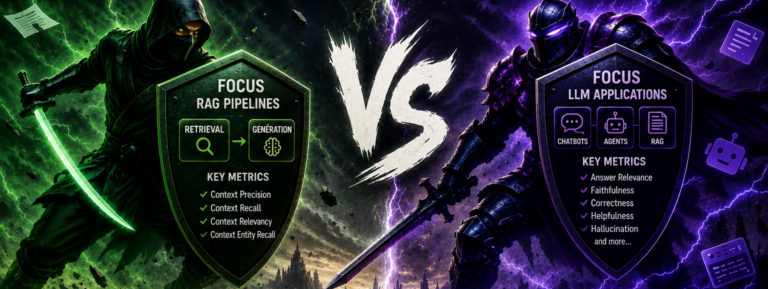
RAGAS and DeepEval both score RAG systems: faithfulness, context precision, contextual relevancy. The metrics overlap 80%. What separates them is where and how you use them. RAGAS was born from a research paper. DeepEval was born from a CI/CD need. It shows in both APIs, and it determines which one you should install first. On…
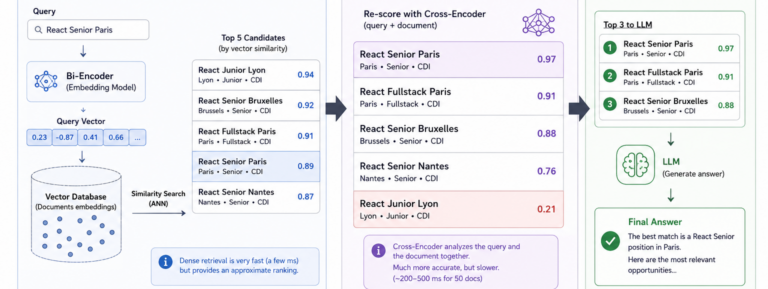
Why Vector Search Alone Isn’t Enough — And How the Retrieve → Re-rank Pipeline Fixes It

Posted on by

I used to think vector search was enough.

It isn’t.

Embeddings capture the overall meaning of a text, not its fine-grained requirements.

And when you search for ** »React Senior Paris »** and get ** »React Junior Lyon »** as the top result, that’s exactly the problem: a search engine that understands the domain, but not the actual query.

I wrote a deep dive on the **Retrieve → Re-rank** pipeline: why Dense Retrieval alone eventually hits its limits, how Cross-Encoders fix the problem, and how the two work together in modern RAG architectures.

Hexagonal Architecture

Posted on by

The hexagonal architecture, also called Ports & Adapters, has two features when it is schematized: a hexagonal shape (hence its name) and a separation between the application, the exterior and a part containing adapters which allows the first two parties to communicate. It was designed by Alistair Cockburn in the 2000s. Its purpose is to…

CQRS PATTERN

Posted on by

CQRS, qui signifie Command Query Responsibility Segregation, est issu du CQS (Command Query Separation) introduit par Bertrand Meyer dans son ouvrage Object Oriented Software Construction. Meyer soumet le principe que les classes d’une méthode doivent être soit des queries soit des commands. La différence entre le CQS et le CQRS résulte dans le fait que chaque object CQRS est divisé en…