Production AI Platform for Automated Job Discovery and Semantic Matching
Executive Summary
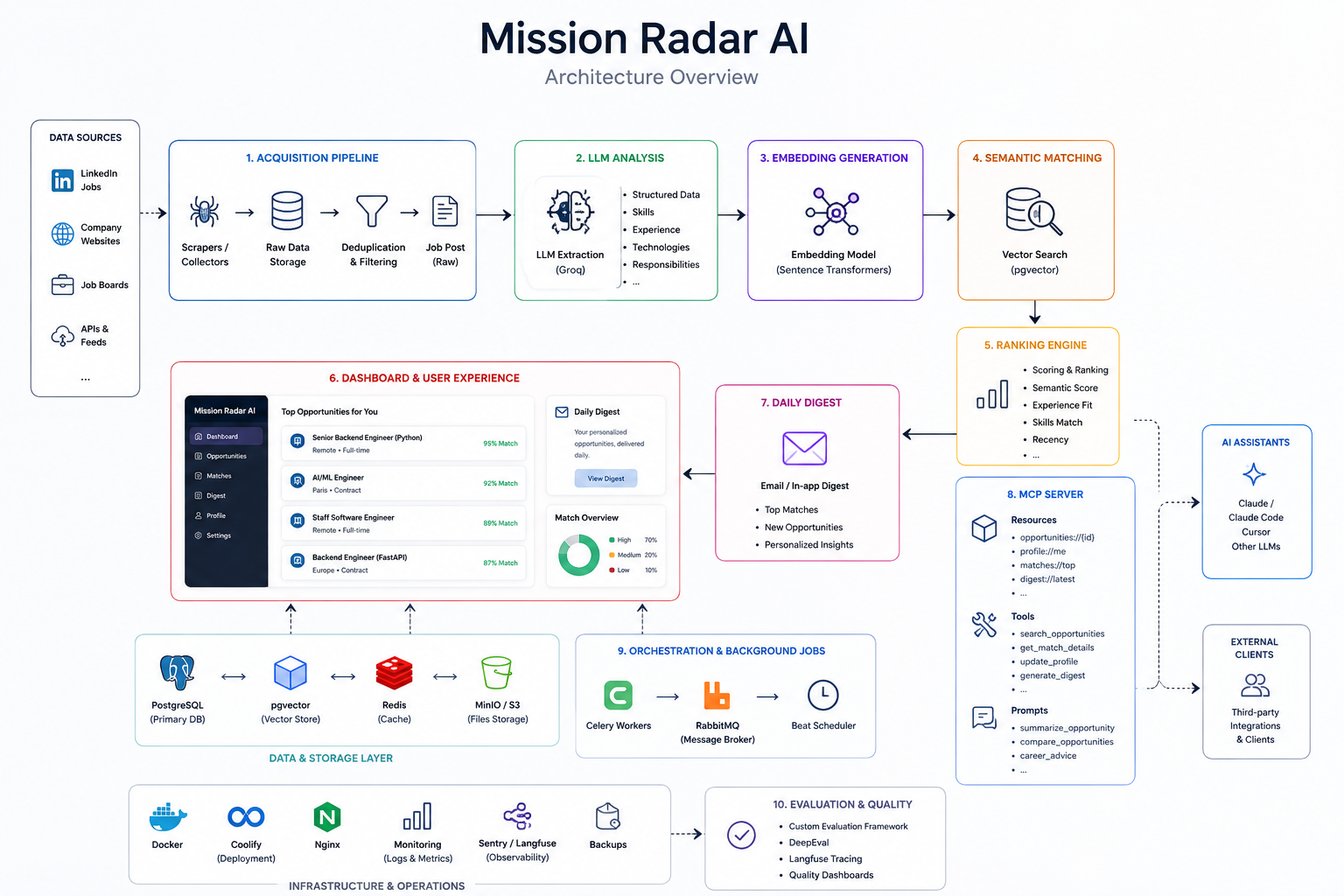
Mission Radar AI is a production-oriented AI platform that continuously discovers software engineering opportunities, analyzes job descriptions using Large Language Models, semantically matches them against a developer profile, and delivers personalized daily digests.
Unlike typical AI demos, the platform combines asynchronous data pipelines, vector search, LLM-based information extraction, semantic ranking, workflow orchestration, evaluation frameworks, authentication and MCP integration into a single production-ready architecture.
The Problem
Finding relevant freelance or permanent opportunities is surprisingly inefficient.
Job boards return hundreds of loosely related offers.
Keyword search ignores context.
LLM applications require much more than prompt engineering:
- data ingestion
- structured extraction
- semantic search
- ranking
- evaluation
- monitoring
- authentication
- orchestration
Building all these components into a reliable production system was the objective of Mission Radar AI.
System Architecture
Technology Stack
Backend
- Python
- FastAPI
- SQLAlchemy
- PostgreSQL
- pgvector
AI
- Groq
- Sentence Transformers
- Embeddings
- Semantic Search
Orchestration
- Celery
- RabbitMQ
- Redis
Architecture
- Clean Architecture
- DDD
- Repository Pattern
- CQRS-inspired use cases
Authentication
- Auth0
- JWT
- MCP Identity Resolution
Frontend
- React
- TypeScript
Infrastructure
- Docker
- Coolify
Evaluation
- Custom Evaluation Framework
- DeepEval
- Langfuse
Key Engineering Decisions
Quelques décisions qui montrent ton niveau d’architecture :
Clean Architecture
The AI pipeline is completely isolated from infrastructure concerns, allowing every use case to be tested independently.
Asynchronous Processing
Long-running tasks such as data collection, LLM analysis and semantic matching are executed through Celery workers, preventing blocking API requests.
Identity as a Business Concern
Instead of exposing infrastructure identities throughout the application, Auth0 JWTs are translated into business identities before entering the application layer.
MCP Integration
Mission Radar exposes Resources, Tools and Prompt Templates through the Model Context Protocol, allowing AI assistants such as Claude Code to interact with the platform safely.
Evaluation First
LLM outputs are benchmarked using an internal evaluation framework combined with DeepEval to measure extraction quality and detect regressions.
Engineering Challenges Solved
- Continuous acquisition pipeline
- Semantic matching
- Structured extraction from unstructured posts
- Duplicate detection
- Pipeline orchestration
- Authentication for MCP
- AI evaluation
- Distributed processing
- Daily digest generation
- Vector search
Production Features
- Multi-user
- JWT authentication
- Background workers
- Retry policies
- Dockerized deployment
- API separation
- React dashboard
- MCP server
- Evaluation framework
- Observability ready
What I Learned
Building production AI systems is far more about software engineering than prompt engineering.
Reliable AI applications require orchestration, evaluation, architecture, authentication, asynchronous processing and monitoring just as much as they require language models.