Executive Summary
AI Evaluation Lab is an independent evaluation framework designed to benchmark RAG pipelines and AI agents using reproducible datasets and automated quality metrics.
Rather than relying on subjective manual reviews, it transforms LLM outputs into measurable engineering signals that can be compared across prompt, retrieval and model iterations.
Because the evaluation engine is completely decoupled from the application under evaluation, the same benchmark can be reused across different AI systems, making evaluation reproducible, comparable and suitable for continuous integration workflows.
Problem
Evaluating LLM applications remains one of the biggest challenges in production AI. Manual reviews are slow, subjective and difficult to reproduce, making it almost impossible to detect quality regressions as prompts, retrieval pipelines or models evolve.
Unlike traditional software, where tests produce deterministic pass/fail results, LLM applications require evaluating probabilistic outputs across multiple quality dimensions such as factual accuracy, relevance and context utilization. Without a structured evaluation process, regressions often remain invisible until they affect end users.
Why This Problem Matters
As AI applications become increasingly integrated into production systems, prompt engineering, retrieval strategies and model upgrades become part of the software lifecycle.
Without automated evaluation, every change introduces uncertainty:
- Did answer quality improve or degrade?
- Is the new retrieval strategy actually better?
- Is the new model worth the additional cost?
- Are regressions acceptable or blocking?
Reliable evaluation becomes an engineering requirement rather than a research exercise. It becomes the foundation for safely evolving AI systems over time.
System Architecture
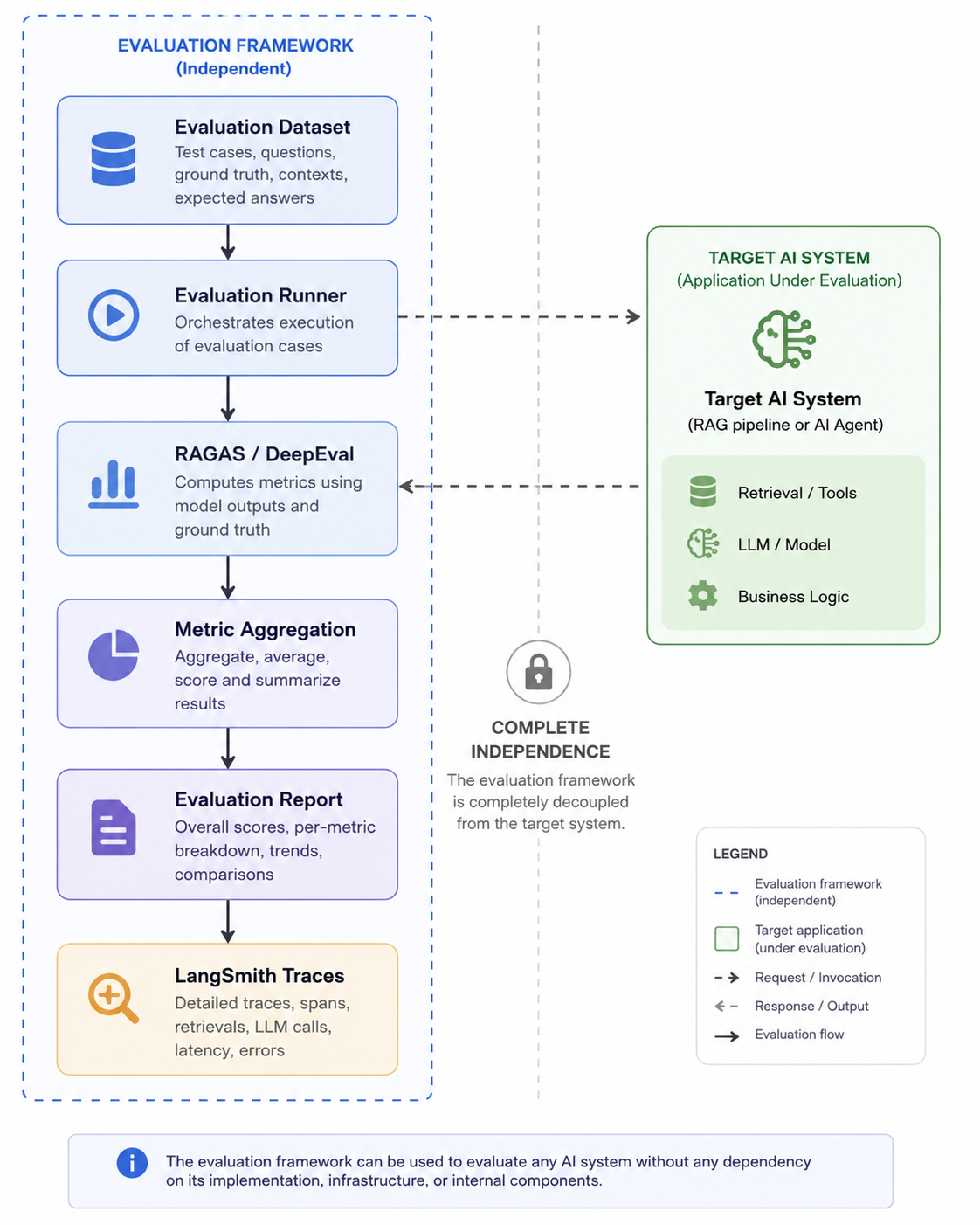
The evaluation framework is intentionally designed as a standalone system rather than a component embedded inside the application being evaluated.
This separation makes the same benchmark reusable across multiple AI systems without modifying evaluation logic.
Technology Stack
- Python
- FastAPI
- RAGAS
- DeepEval
- LangSmith
Key Engineering Decisions
Standalone Evaluation Framework
Designed the evaluation engine as an independent framework rather than embedding evaluation directly into the application.
This architectural decision allows the same benchmark to evaluate multiple RAG pipelines or AI agents without coupling evaluation logic to business logic, making benchmarks reusable across projects.
Complete Separation of Concerns
The framework only interacts with the public interface of the application under evaluation.
It has no dependency on the application’s internal implementation, business logic, infrastructure or deployment model.
This architectural boundary makes the evaluation engine reusable across heterogeneous AI systems while preserving complete implementation independence.
Framework-Agnostic Evaluation
Instead of relying on a single evaluation framework, the system integrates both RAGAS and DeepEval.
Each framework evaluates different quality dimensions and exposes different trade-offs. Supporting multiple evaluators makes benchmarking more comprehensive while reducing dependency on a single evaluation methodology.
Reproducible Benchmarks
Evaluation datasets are treated as reusable engineering artifacts rather than ad-hoc test cases.
Running the same benchmark repeatedly makes it possible to compare prompt iterations, retrieval strategies and model versions under identical conditions.
Evaluation Methodology
Each benchmark executes the same evaluation dataset against the target AI system.
For every evaluation case, the framework collects the generated response and computes multiple complementary quality metrics including:
- Faithfulness
- Answer Relevancy
- Context Precision
- Context Recall
- Hallucination Rate
The resulting metrics provide a quantitative view of answer quality, making it possible to detect regressions that would be difficult to identify through manual inspection alone.
Trade-offs
LLM evaluation is inherently probabilistic.
Using LLMs as judges provides richer semantic evaluation than deterministic rules, but introduces variability between evaluation runs.
Rather than eliminating this uncertainty, the framework embraces it by combining multiple metrics and treating evaluation results as engineering signals rather than absolute truth.
For this reason, evaluation should be interpreted as statistical evidence rather than deterministic truth.
Production Considerations
The framework was designed with production evaluation workflows in mind.
Key design goals include:
- reproducible benchmark execution;
- reusable evaluation datasets;
- framework-independent architecture;
- support for automated regression testing;
- observability through LangSmith traces.
These characteristics make the framework suitable for integration into CI/CD pipelines as AI applications evolve.
The framework was designed to integrate naturally into engineering workflows rather than remaining a standalone experimentation tool.
Results
The framework transforms subjective LLM outputs into measurable quality metrics, enabling engineering teams to compare prompt iterations, retrieval strategies and model versions using reproducible benchmarks instead of manual reviews.
Rather than answering the question:
« Does this response look better? »
the framework enables teams to answer:
« Did the system actually improve? »
Metrics Tracked
- Faithfulness
- Answer Relevancy
- Context Precision
- Context Recall
- Hallucination Rate
What I Learned
Building this framework fundamentally changed the way I think about LLM evaluation.
Traditional software testing assumes deterministic behavior: the same input should always produce the same output. LLM applications challenge that assumption. In practice, the evaluator itself is another language model with its own biases, limitations and uncertainty.
This experience reinforced an important lesson: evaluation scores should not be treated as absolute truth, but as engineering signals that help guide better decisions. Designing reliable AI systems therefore requires not only measuring model quality, but also understanding the limitations of the measurement process itself.
Design Principles
Framework-independent
Reproducible by default
Evaluation as code
Observable execution
Reusable datasets
Metric-driven decisions
Future Directions
- Human-in-the-loop evaluation workflows.
- Cost-aware benchmark comparison.
- Versioned evaluation datasets.
- Additional evaluation frameworks.
- Historical benchmark dashboards.
- Continuous evaluation integrated into CI/CD.